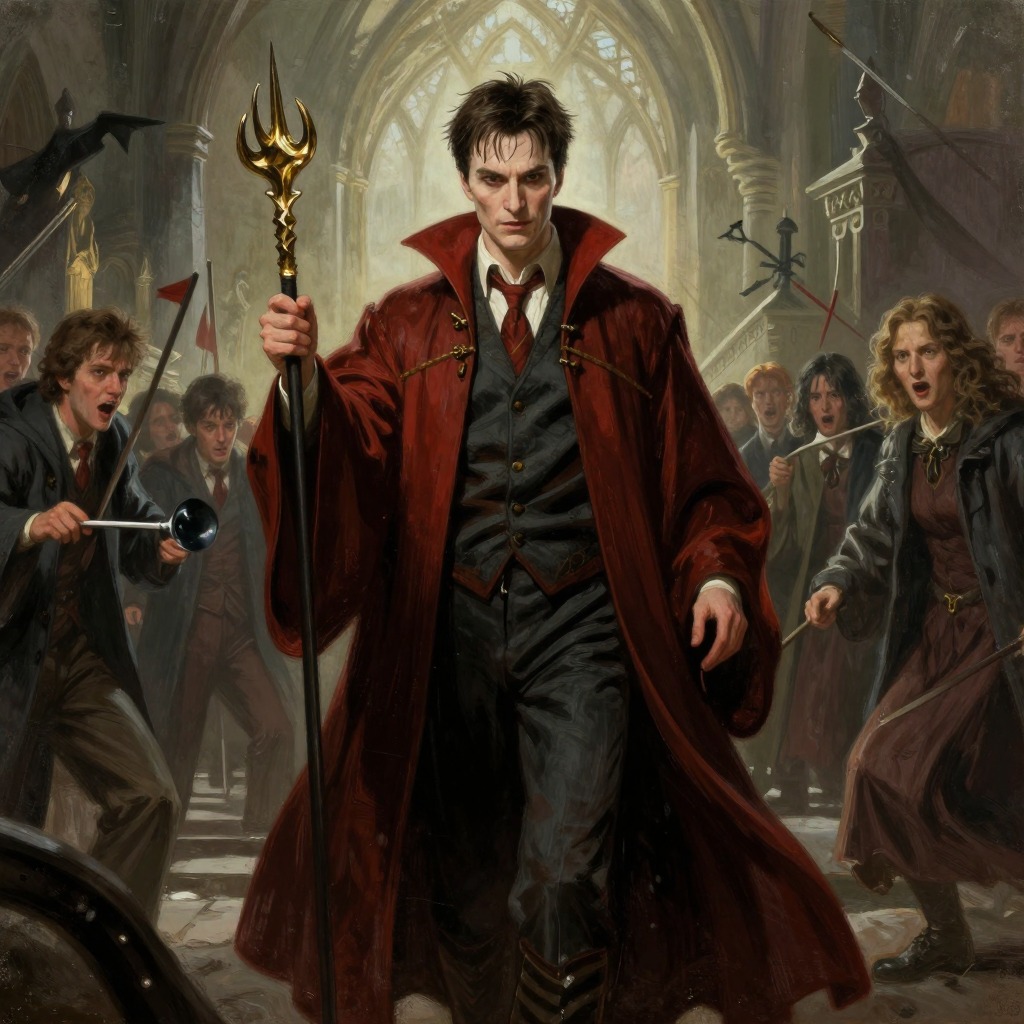
Death Eater
The Death Eater identity is the central antagonistic force in the Wizarding world, representing a clandestine organization of Dark wizards and witches bound by loyalty to Lord Voldemort. In the sixth year at Hogwarts, the nature of this identity is explored through its recruitment, its internal hierarchies, and the escalating terror it inflicts upon both the magical and Muggle communities. The Death Eaters are no longer a rumor; they are an open, war-making entity, and their mark—the Dark Mark—has become a symbol of imminent death and destruction.
Identity and Initiation
The Death Eater identity is not merely a political affiliation but a profound, magical bond. Members are branded with the Dark Mark on their left forearm, a skull with a serpent tongue that burns when Voldemort summons them and grows stronger as he regains power. This mark serves as both a badge of honor and a tool of control. The question of who can become a Death Eater is central to the year's plot. Harry Potter becomes convinced that Draco Malfoy has been initiated, replacing his imprisoned father, Lucius. Harry's suspicion is based on Malfoy's behavior: he flinches when Madam Malkin tries to touch his left arm in the robe shop, and he later threatens Mr. Borgin by showing him something unseen that terrifies the shopkeeper. Harry interprets this as Malfoy displaying the Dark Mark to prove his authority. The idea that a sixteen-year-old could be a Death Eater is initially met with skepticism by Ron and Hermione, but Harry's theory is later supported by Malfoy's own boasts on the Hogwarts Express, where he hints at a special mission from Voldemort and suggests he might not need to complete his education. This reveals that the organization is willing to recruit young, desperate, and ambitious individuals, valuing service and devotion over formal qualifications.
Internal Dynamics and Hierarchy
The Death Eaters are not a monolithic group; they are riven by internal rivalries, suspicion, and a strict hierarchy based on Voldemort's favor. This is vividly demonstrated in the confrontation between Severus Snape and Bellatrix Lestrange at Spinner's End. Bellatrix openly questions Snape's loyalty, accusing him of failing to find Voldemort after his fall, of protecting Harry Potter, and of enjoying Dumbledore's trust. Snape defends himself by claiming he acted on Voldemort's orders to spy at Hogwarts, that he remained in place to gather information, and that he kept Harry alive only because Voldemort needed his blood for the resurrection. The exchange reveals a culture of paranoia and backstabbing, where Death Eaters jockey for position and constantly prove their worth. Bellatrix's own status is shown to be precarious after the fiasco at the Ministry of Magic, and Snape subtly mocks her. The hierarchy is further illustrated by the treatment of Peter Pettigrew, who is reduced to a servant, forced to fetch drinks and clean house, a clear sign of his low status within the organization. The ultimate expression of this internal dynamic is the Unbreakable Vow, where Narcissa Malfoy, desperate to protect her son Draco, forces Snape to swear a magical oath to assist Draco in his mission and to complete it if he fails. This vow, witnessed by Bellatrix, binds Snape under pain of death, demonstrating how personal loyalties and fears can override the organization's chain of command.
Methods and Public Threat
The Death Eaters' methods in this period are characterized by terror, sabotage, and indirect attacks. They are responsible for a series of seemingly unrelated disasters that the Muggle Prime Minister is forced to confront: the collapse of the Brockdale Bridge, a freak hurricane in the West Country, and the murders of Amelia Bones and Emmeline Vance. Cornelius Fudge reveals that these were not accidents but the work of Voldemort and his followers, including the use of giants. The Death Eaters also deploy Dementors, who have deserted Azkaban to join Voldemort, spreading despair and a chilling mist across the country. Their attacks on Hogwarts are more targeted but equally ruthless. They attempt to smuggle in a cursed opal necklace via Katie Bell, intending it for Dumbledore, and later poison a bottle of mead meant for him, which nearly kills Ron Weasley. These plots, orchestrated by Draco Malfoy with the help of an Imperiused Madam Rosmerta, show a willingness to kill innocents to reach their primary target. The ultimate demonstration of their power and reach is the invasion of Hogwarts itself. Using a pair of Vanishing Cabinets, Death Eaters including Fenrir Greyback, Amycus and Alecto Carrow, and Thorfinn Rowle bypass the school's defenses. They fight their way to the Astronomy Tower, where Malfoy confronts a weakened Dumbledore. The climax of their assault is the murder of Albus Dumbledore by Severus Snape, an act that shatters the Wizarding world's sense of security and proves that no place, not even Hogwarts, is safe from Voldemort's reach.
The Nature of the Threat
The Death Eater identity is ultimately defined by its relationship to Voldemort. They are not independent agents but extensions of his will, driven by fear, ambition, or a shared ideology of pure-blood supremacy. The year reveals that even those within the organization are terrified of their master. Draco Malfoy is shown crying in a bathroom, confessing to Moaning Myrtle that he cannot complete his task and that Voldemort will kill him if he fails. This vulnerability humanizes him but also underscores the brutal, coercive nature of the organization. The Death Eaters are a force of chaos and destruction, but they are also a collection of deeply flawed, fearful individuals bound by a magical oath and a common cause. Their ultimate goal, as stated by Voldemort, is to achieve immortality and absolute power, and they are willing to commit any atrocity to achieve it.